


Table of Contents
- Why Boutique Clothes Deserve a Closer Look
- Signs of High Quality Clothing Construction
- How to Check Fabric Quality Before Buying
- The Tactile Test: What Your Hands Can Tell You
- Best Affordable Boutique Clothing Brands 2026
- Cost-Per-Wear: The Real Math Behind Quality
- Common Mistakes When Judging Boutique Quality
- Frequently Asked Questions
Last Updated: October 4, 2026
Why Boutique Clothes Deserve a Closer Look
Learning how to tell if boutique clothes are high quality comes down to one habit: ignore the label and inspect the garment.
Boutique clothing is apparel sold in small quantities by independent shops that curate their own selection, rather than mass-produced lines sold in large chains.
Below are the exact checks we use when choosing pieces for our own shelves.
Signs of High Quality Clothing Construction
Good construction is the fastest signal of a well-made garment, and you can spot it in under a minute without tools. Turn the piece inside out and look at how it was put together, most shoppers never do this.
Stitching Integrity and Seam Strength
Start with the seams. A quality garment uses tight, even stitches with no loose threads or skipped sections, and the inside seam should feel flat and smooth, not bumpy or twisted.
Look for these markers of stitching integrity:
- Stitch density: More stitches per inch means a stronger seam. Sparse, wide stitches pull apart faster.
- Clean seam finishes: Serged or bound edges resist fraying. Raw, unfinished edges will unravel over time.
- Reinforced stress points: Check underarm seams, pocket corners, and where straps attach.
A smooth exterior can hide weak interior seams, so flip it inside out every time.
Hardware, Trim, and Lining Inspection
Zippers, buttons, and clasps tell you how much care went into a piece. Cheap hardware feels light and flimsy. Quality hardware has weight and moves smoothly.
Check these details:
- Zippers that glide without catching or sticking
- Buttons sewn on with a shank or cross-stitch, not two loose threads
- Metal clasps that feel solid, not hollow
A well-made lining is a strong quality signal, it costs more to produce, so brands that skip it are cutting corners elsewhere too. On our Golden Tapestry and Pearl Button Down Dress, the fabric-covered buttons and finished cuffs are exactly the detailing we look for.
How to Check Fabric Quality Before Buying
Fabric quality determines how a garment feels, washes, and lasts, and you can assess most of it before trying anything on. Start with the label, then use your hands, then decode the care tag.
Reading Fiber Content and Care Labels
The fiber content tag is the most honest part of any garment, listing what the fabric is made of by percentage. Read the whole list in order, fibers are listed by weight, highest to lowest.
Here's what to look for:
- Natural fibers like cotton, wool, linen, and silk breathe well and age gracefully
- Synthetic blends like polyester and acrylic add stretch and wrinkle resistance
- High natural fiber content usually signals better comfort and durability
A 55% cotton / 45% acrylic blend, like our Oatmeal Quarter-Zip Sweater, balances softness with shape retention and holds up to repeated washing better than all-synthetic knits.

Decode the blend, not just the fiber. Patterns worth memorizing:
- 100% cotton is durable and breathable but shrinks and wrinkles unless it's been pre-shrunk or garment-washed. Look for those words on the tag.
- Cotton/poly blends around 60/40 resist shrinking and pilling better than pure cotton, which is why they show up in everyday knits.
- 100% polyester can be durable, but it traps odor and pills faster at friction points like underarms and cuffs.
Care label symbols are a durability forecast. The Federal Trade Commission requires care labels on most U.S. apparel, following the ASTM D5489 standard. You don't need the whole chart, just read the pattern:
- Machine wash cold, tumble dry low = the maker expects the garment to survive normal wear.
- Machine wash gentle, lay flat to dry = the fabric is delicate enough that heat will distort it, but it's still home-maintainable.
- Dry clean only = either the fiber is genuinely fragile (silk, some wools) or the maker skipped the pre-shrinking and finishing steps that would make it washable. Both are worth knowing before you pay.
Fabric Weight and GSM Explained
GSM stands for grams per square meter, measuring how heavy and dense a fabric is.
Here's a rough guide for knits:
| GSM Range | Weight | Best For |
|---|---|---|
| 120-160 | Lightweight | Summer tees, thin tops |
| 160-220 | Midweight | Everyday shirts, layering pieces |
| 220-300 | Heavyweight | Sweaters, winter knits |
| 300+ | Very heavy | Outerwear, structured coats |
Thin, see-through fabric is often a low-GSM sign. Hold a piece to the light: if you can see your hand clearly through it, the fabric is light, fine for summer, but not for a sweater meant to last winters.
Weave and knit structure matter as much as weight. Two fabrics at the same GSM can wear very differently:
- Tight plain weave (poplin, broadcloth) resists snags and holds a press.
- Loose twill or oxford weave is softer but more prone to pilling at friction points.
- Single jersey knit is thin and stretchy, fine for tees, weak for anything structural.
The stretch-recovery test ties it together. Pinch a knit, pull it about an inch, then release.
FTC care labeling rule and ASTM D5489 symbol guide
The Tactile Test: What Your Hands Can Tell You
Your hands are the best quality tool you own, touch tells you more than any tag.
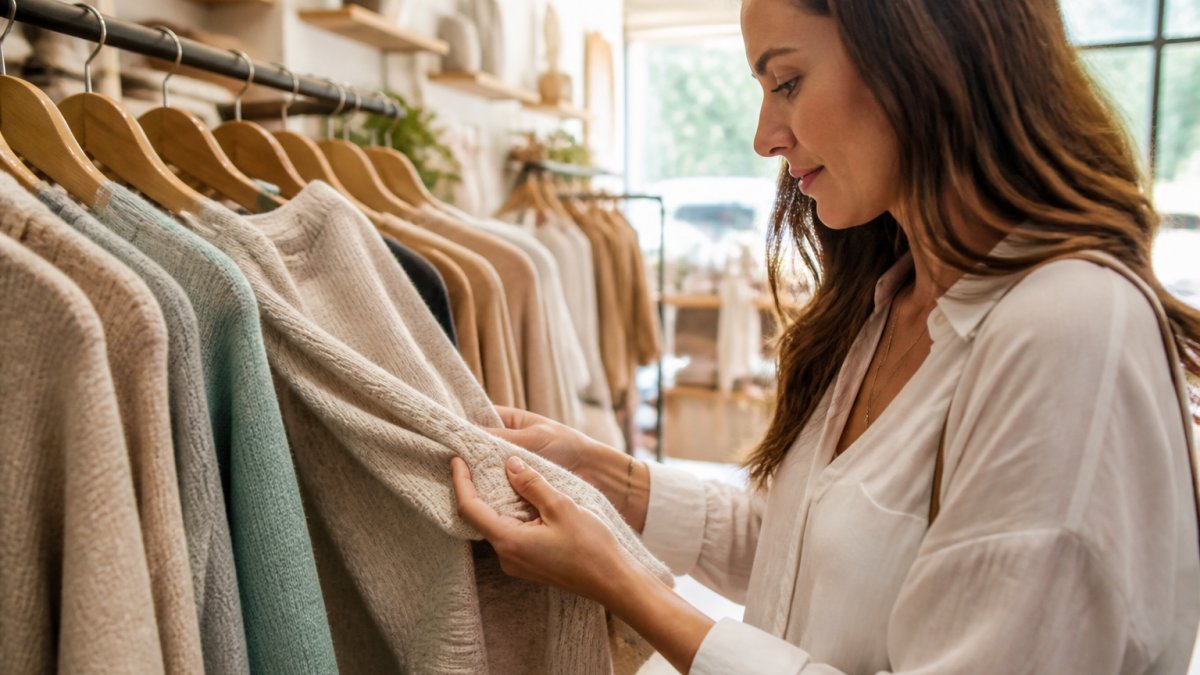
Squeeze the fabric and let go: quality material springs back, while cheap material stays wrinkled or stretched.
Try these physical checks:
- The stretch test: Pull gently. Good knits recover; weak ones stay baggy.
- The scrunch test: Crumple the fabric in your fist. It should relax, not stay creased.
- The drape test: Hold it up. Quality fabric falls in soft folds, not stiff angles.
What most guides miss is the sound. Rub the fabric near your ear. A quiet, soft rustle suggests natural fibers. A loud, crinkly sound often points to synthetic blends.
Best Affordable Boutique Clothing Brands 2026
Finding affordable boutique clothing in 2026 means knowing what "affordable" really costs. A lower price means nothing if the piece falls apart after three washes, real value comes from construction, fabric, and longevity.
This is where MK Collective fits.
A few things to look for in any affordable boutique:
- Clear fiber content on every listing
- Real customer photos, not just studio shots
- A return policy that covers fit issues
Our Oatmeal Cashmere Blend Sweater Shirt and Pearly Gold Chain Necklace show how we think about value. The necklace is titanium steel, tarnish-free, and water resistant, so it keeps its shine through daily wear.


Cost-Per-Wear: The Real Math Behind Quality
Cost-per-wear is the price of a garment divided by how many times you wear it. It's the honest way to compare a cheap piece against a better-made one.
A $20 top worn twice costs $10 per wear. A $60 top worn 30 times costs $2 per wear. The pricier piece wins by a wide margin.
Here's how to run the math:
- Divide the price by your realistic number of wears per year.
- Multiply by the years you expect it to last.
- Compare that number across similar pieces.
Quality garments usually win this calculation: they keep their shape, resist pilling, and stay in rotation longer, while fast fashion pieces lose fit and color after a few washes, pushing the real cost up.
The Three Inputs Most People Get Wrong
The formula is simple. The inputs are where the math breaks down.
- Wears per year is not wears per week times 52. Be honest. A statement dress might get worn four times a year, not forty. A basic tee might get worn twice a week. Plug in the real number, not the aspirational one.
- Years of life is not the same as years you'll keep it. A well-made wool coat can physically last a decade, but if you replace it after three seasons because the style dates, the cost-per-wear should reflect three years, not ten.
- Maintenance cost belongs in the numerator. Dry cleaning at roughly $10-$15 per visit, plus repairs, adds up. A $200 jacket that needs dry cleaning twice a season for five years carries about $100-$150 in hidden cost on top of the sticker price.
A Worked Comparison
Say you're choosing between two sweaters:
| Fast-fashion knit | Boutique knit | |
|---|---|---|
| Price | $35 | $120 |
| Wears per year | 8 | 20 |
| Years of life | 1 | 4 |
| Total wears | 8 | 80 |
| Cost per wear | $4.38 | $1.50 |
| Maintenance | Machine wash, pills by month 3 | Hand wash, holds shape |
The boutique knit costs 3.4x more up front and 2.9x less per wear. That gap is the entire argument for inspecting construction before you buy, the stitching, fabric weight, and hardware checks above predict whether a garment lands in the "4 years" column or the "1 year" column.
The Resale and Repair Multiplier
This is the part most cost-per-wear guides skip: a garment with strong construction doesn't just last longer, it holds value on the secondary market and can be repaired instead of replaced.
- Resale value.
- Repairability. A garment with a generous seam allowance, a replaceable button placket, and a real lining can be altered or mended by a tailor. A fused, glued, or raw-edged fast-fashion piece usually can't. A $15 hem repair on a $120 sweater extends its life by years; the same repair on a $35 sweater often costs more than the garment is worth.
- The repair test. Before you buy, look at the inside seam allowance. If there's at least a half-inch of fabric beyond the stitch line, the garment can be let out or taken in. If the seam is trimmed flush, it can't.
When Cheap Actually Wins
Cost-per-wear isn't a blanket argument for spending more. There are cases where the cheap piece is the right call:
- Trend pieces you'll wear one season. A $25 novelty top worn ten times beats a $150 version worn the same ten times.
- Items you'll abuse. Gardening clothes, painting shirts, kids' playwear, buy the cheap version and don't feel bad.
- Fit experiments. If you're trying a new silhouette for the first time, a low-cost test piece tells you whether you'll actually wear the shape before you invest.
The rule isn't "always buy quality." It's "know which column you're in before you spend."
Common Mistakes When Judging Boutique Quality
Most shoppers make the same errors. Avoiding them puts you ahead of the crowd.
- Trusting the price tag. A high price does not guarantee premium materials. Check the garment, not the number.
- Judging by brand reputation alone. A known name can still cut corners on a specific item.
- Skipping the inside. Seams, linings, and tags hide the truth about garment construction.
One more mistake: assuming all small-batch clothing is artisanal. Small scale helps, but it isn't proof. The stitching and fabric still have to hold up.
Frequently Asked Questions
Are boutique clothes actually better quality than mass-market brands?
Not automatically. Boutique clothes can be higher quality because smaller runs allow for closer attention to garment construction, but the label alone does not guarantee it. Check stitching density, fabric weight, and hardware yourself. A boutique sweater with tight, even seams and substantial fabric will outlast a mass-produced piece with loose threads and thin material, regardless of what the tag says.
What specific fabric details indicate high-quality clothing?
Look at the fiber content on the care label. Natural fibers like cotton, wool, and silk tend to breathe better and age well, while synthetic blends can pill or lose shape. Feel the fabric weight: a heavier knit usually holds its shape longer. Check for a tight weave by holding the fabric up to light. If you can see through it easily, it may not survive many washes.
How can you tell if a garment will last after multiple washes?
Inspect the seams before buying. A quality garment has tight, consistent stitching with no loose threads. Check that buttons are securely attached and zippers glide smoothly. Read the care label and follow it. Machine washing on gentle with cold water and laying flat to dry, as recommended for pieces like the Oatmeal Quarter-Zip Sweater, preserves fabric and construction far longer than harsh cycles.
Does a higher price tag always mean better quality clothing?
No. Price reflects branding, marketing, and retail markup as much as materials. A $200 blouse can have the same seam quality as a $60 one. Use cost-per-wear instead: divide the price by how many times you will realistically wear it. A well-made $62 dress worn weekly for two years costs less per wear than a $25 top that pills after five washes.
Quality clothing doesn't have to be expensive, and it shouldn't fall apart after a few washes. At MK Collective, we handpick every piece with that in mind, from comfortable kids' knits to tarnish-free jewelry and everyday women's styles. Our small, family-run shop gives you a simple one-stop experience, affordable prices, and a curated selection built for real life. Explore all collections at MK Collective and find pieces your family will actually keep wearing.