


Table of Contents
- Living Room Layouts That Work for Kids and Adults
- Durable Fabrics for Family Furniture That Actually Last
- Functional Storage Solutions for Modern Homes
- How to Style a Family Room With Kids in Mind
- Lighting, Natural Light, and Greenery for Warmth
- Modern Home Decor for Family Homes: Pet-Friendly and Budget-Friendly Upgrades
- Sustainable and Non-Toxic Material Sourcing
- Frequently Asked Questions
Last Updated: September 20, 2026
Living Room Layouts That Work for Kids and Adults
Modern home decor for family homes starts with the floor plan, not the furniture. A living room that works for kids and adults uses an open-concept layout with a clear traffic path, a defined play zone, and seating that faces inward rather than toward a screen. This guide from MK Collective covers what holds up in real family life.
Durable Fabrics for Family Furniture That Actually Last
Durable fabrics for family furniture come down to weave density and fiber type, not marketing labels. Solution-dyed acrylic, tightly woven polyester blends, and leather outlast cotton and linen in high-traffic areas; look for a double rub count above 30,000 for a sofa that sees daily use.
Performance Upholstery and High-Traffic Area Materials
Performance upholstery is fabric engineered to resist stains, fading, and abrasion through a tight weave or factory-applied finish. Crypton, Sunbrella, and similar textiles are common in family homes for good reason: spills bead up, and most stains lift with water and a cloth.
- Tight weaves over loose knits, which snag on toys and zippers
- Mid-tone colors that hide crumbs and pet hair better than white or black
- Removable covers where possible, so one stained cushion doesn't ruin the set
Functional Storage Solutions for Modern Homes
Functional storage solutions for modern homes hide the mess without hiding the personality. The most effective family storage combines closed cabinetry for clutter with open shelving for accent pieces. Baskets, lift-up benches, and wall-mounted cubbies handle the daily overflow of shoes, toys, and backpacks.
Multi-Purpose Furniture and Modular Pieces
Multi-purpose furniture is the backbone of a family-friendly room. An ottoman that opens into storage, a coffee table with a lower shelf for bins, and a bench that doubles as entry seating all earn their footprint.
| Storage Type | Best For | Watch Out For |
|---|---|---|
| Closed cabinetry | Hiding toys and clutter | Kids forget what's inside |
| Open baskets | Quick daily cleanup | Baskets overflow fast |
| Lift-up benches | Entryway shoes and bags | Hinges wear with heavy use |
| Modular shelving | Growing families | Can look unfinished without styling |
How to Style a Family Room With Kids in Mind
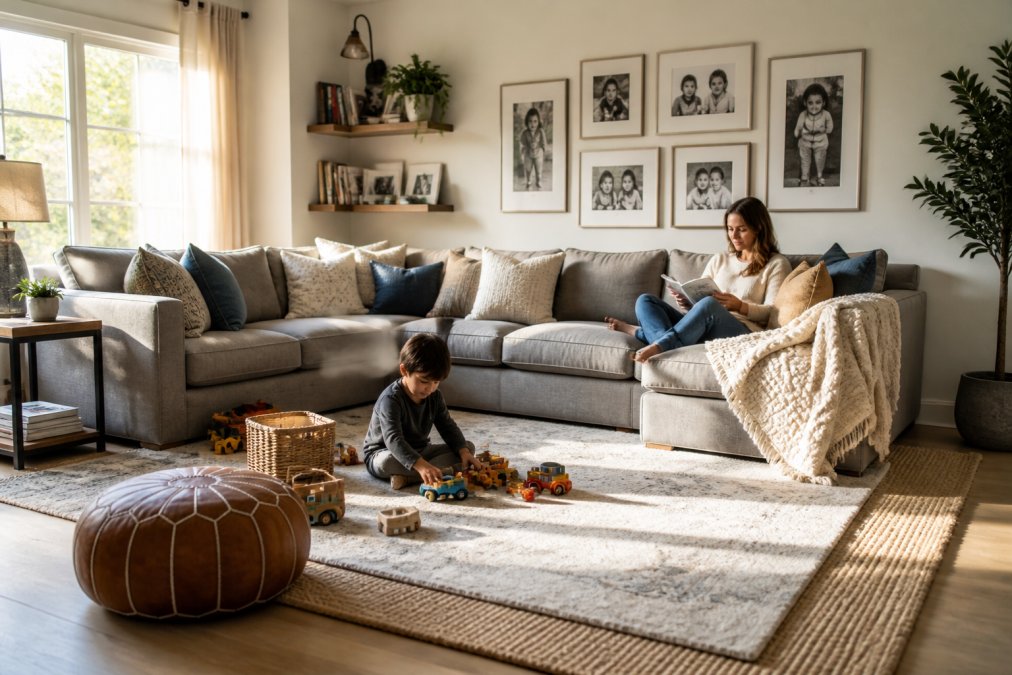
Styling a family room for kids means designing for function first and beauty second, then layering the two. What separates a styled family room from a decorated one is sequencing: anchors first, then textiles, then the small objects that carry personality.
Start With the Anchors, Not the Accessories
Work in this order and the room will hold together even after a playdate:
- Rug first. A washable rug sized so the front legs of every seat sit on it, typically an 8x10 or 9x12 for a standard sectional, defines the zone and absorbs noise.
- Sofa second. A performance-fabric sofa in a mid-tone is the visual and functional center.
- Wall third. A gallery wall you can add to as the family grows.
- Textiles fourth. A chunky knit throw, a woven basket, and one or two low-light-tolerant plants.
- Objects last. Books, a tray, a candle, the layer that gets cleared before guests arrive.
Color Palettes That Tolerate Fingerprints
Warm minimalism works well in family rooms because it keeps surfaces clear without feeling cold. The practical version is a three-color system: one warm neutral for the largest surfaces (sofa, rug, walls), one mid-tone for contrast (charcoal, olive, terracotta, or navy), and one accent you can swap cheaply through pillow covers.
- Warm white or greige on walls hides scuffs better than cool gray.
- Mid-tone upholstery in oatmeal, mushroom, or slate hides crumbs and pet hair better than white or black.
- One saturated accent, rust, mustard, deep green, reads as intentional rather than childish.
A Gallery Wall That Grows With the Family
A gallery wall is the easiest way to inject personality without adding clutter. Mix framed family photos with a child's artwork in matching frames, and keep the layout tight so it reads as one composition.
A few mechanics that make the difference:
- Pick one frame finish (black, natural wood, or brass) and vary only the size.
- Keep 2 to 3 inches between frames so the group reads as a single unit.
- Hang the center of the composition at eye level, roughly 57 to 60 inches from the floor.
- Use acrylic glazing instead of glass in kids' zones; it survives a stray ball.
- Leave one empty frame on the wall so new artwork has a home the moment it comes home from school.
Style for the Age in the Room
The same room has to work for a toddler and a ten-year-old. Adjust the bottom 3 feet, not the whole room:
- Toddlers: soft floor cushion, rounded-edge side tables, nothing breakable below waist height, outlet covers on every accessible outlet.
- School-age kids: a low shelf or bin system they can reach and reset themselves, plus a clear surface for homework or projects.
- Teens: a charging station, a spot for headphones, and at least one zone they can personalize without touching the rest of the room.
The One Zone That's Yours
Build in one area that is genuinely adult, a reading chair with a side table, a bar cart, or a console with a lamp. It doesn't need to be large, just untouched by toys, so the room doesn't read as a playroom with a sofa in it.
Lighting, Natural Light, and Greenery for Warmth
Layered lighting separates a room that feels cozy from one that feels like an office. Combine overhead ambient light with task lamps and one warm accent source, then let natural light do the heavy lifting during the day. Window treatments should filter rather than block, keeping light without glare.
Modern Home Decor for Family Homes: Pet-Friendly and Budget-Friendly Upgrades
Modern home decor for family homes has to survive pets and a budget, and both are solvable. Pet-friendly design means choosing materials that resist claws, fur, and accidents, while budget-friendly upgrades come from swapping small things rather than replacing whole rooms.
Pet-Friendly Materials: What Actually Survives
Claws and accidents fail fabric in two ways: claws snag and pull loops, accidents soak and stain. You need a material that resists both.
- Tight, flat weaves, microfiber, bonded leather, and tightly woven performance polyester, let claws slide rather than catch. Loose boucle, chenille, tweed, and any looped or cut-pile carpet are the opposite: they snag, pill, and hold odor.
- Solution-dyed acrylic and polypropylene hold color through the fiber rather than on it, so repeated cleaning doesn't fade them.
- Full-grain or top-grain leather is the most forgiving surface in a pet household. It wipes clean, doesn't hold hair, and surface scratches blend into the patina. Bonded leather is the budget compromise; it is less durable but far cheaper to replace.
- Rugs: choose flat-weave, indoor-outdoor polypropylene, or washable cotton over wool and shag. Wool holds odor; shag traps hair and hides accidents until they smell.
A few mechanics that matter more than the label:
- Color: mid-tone and patterned hides fur and stains better than solid white, cream, or black.
- Cushion construction: removable, zippered covers let you wash one cushion instead of replacing a sofa.
- Legs over skirts: a sofa on visible legs lets you sweep or vacuum underneath instead of chasing fur into a fabric skirt.
- Throws as armor: keep a washable throw on the pet's favorite seat. It is cheaper to launder a throw weekly than to clean a sofa quarterly.
Budget-Friendly Upgrades That Read as a Redesign
You don't need new furniture to change how a room feels. Focus on the five changes that carry the most visual weight per dollar:
- Swap pillow covers and throws to shift the color palette. Covers cost a fraction of new pillows and store flat between seasons.
- Add a large washable rug to anchor the seating area. A rug that is too small is the single most common reason a room looks unfinished.
- Reframe existing photos into matching frames for a gallery wall. Uniform frames do more for cohesion than new art.
- Replace dated hardware on cabinets, doors, and drawers. This is the highest-return change in a kitchen or entryway.
- Add one statement light fixture or a pair of matching lamps to give the room a deliberate focal point.
DIY Modern Upgrades on Furniture You Already Own
The cheapest modern upgrade is the furniture already in your house. A few weekend-level changes:
- Paint or stain a dated wood piece in a single flat color, matte black, warm white, or deep green, to move it from traditional to modern.
- Swap tapered or ornate legs for straight, slim legs on a sofa, console, or dresser. The silhouette does most of the work.
- Replace knobs and pulls with simple bar or cup hardware in a single finish.
- Add a floating shelf above a console or desk to create vertical storage without a new cabinet.
- Recover a bench or ottoman with a performance fabric remnant instead of replacing it.
Where Pet-Friendly and Budget-Friendly Meet
The two goals overlap more than they conflict. Flat-weave washable rugs, removable cushion covers, mid-tone performance fabrics, and secondhand solid-wood furniture you refinish all serve both. Buy the durable anchor once, then rotate the cheap, washable, replaceable layer on top as the household, and the pet, changes.
Sustainable and Non-Toxic Material Sourcing
Sustainable material sourcing is the angle most modern home decor guides skip, and it matters most in a house with kids. Look for solid wood over particleboard, low-VOC or water-based finishes on painted furniture, and textiles certified for low chemical content. The U.S. Environmental Protection Agency's guidance on indoor air quality is a practical starting point for what to avoid in a family space.
- Choose solid wood, bamboo, or metal over composite where the budget allows
- Air out new furniture and rugs for a few days before bringing them inside
- Prefer natural fibers like cotton, wool, and linen for items kids touch most
- Wash new textiles before use to reduce surface finishes
Frequently Asked Questions
What home decor is trending right now for families?
Warm minimalism leads in 2026. Families are choosing neutral color palettes with textural contrast from layered rugs, performance upholstery, and natural materials like wood and linen. Open-concept living spaces get defined by multi-purpose furniture and functional storage solutions rather than walls. Indoor plants and layered lighting add a cozy atmosphere without clutter, and gallery walls display family photos in a way that feels intentional rather than chaotic.
What is the 3-5-7 rule in decorating?
The 3-5-7 rule is a styling guideline for arranging accent pieces like vases, candles, or decorative objects. You group items in odd numbers: three small items, five medium items, or seven total pieces across a shelf or table. Odd numbers create visual interest and asymmetry that feels natural. In family homes, apply it to open shelving or coffee table styling, but keep breakable items on higher shelves away from young children.
How do you make a modern home feel warm and inviting for families?
Start with layered lighting: combine overhead fixtures with floor lamps and table lamps for adjustable brightness. Add textural contrast through rug layering, throw blankets, and window treatments in soft fabrics. Choose a color palette with warm undertones instead of stark white and gray. Bring in indoor plants and natural materials like wood and woven baskets. Finally, display personal items like family photos and a soy wax candle from MK Collective to make the space feel lived-in and welcoming.
What durable fabrics work best for family furniture?
Performance upholstery fabrics like polyester blends, microfiber, and treated cotton handle high-traffic areas well. Look for fabrics labeled stain-resistant or easy-clean, which hold up to spills and daily use. Leather and faux leather wipe clean quickly. For slipcovers and throws, choose machine-washable options. Wool blends resist pilling and fading. Avoid delicate fabrics like silk or light-colored velvet in rooms where kids and pets spend time, since they show wear and stains faster.
Furnishing a family home that looks intentional and survives real life is a genuine balancing act, and most rooms don't get there in one shopping trip. MK Collective curates home goods, clothing, and self-care in one place so busy families can find pieces that fit both the aesthetic and the budget, from soy wax candles that warm a room to the small accents that pull a space together. Explore the collections at MK Collective and build a home that works as hard as you do.