


Table of Contents
- Step 1: Conduct a Kids' Closet Audit
- Step 2: Choose a Color Palette and Capsule Foundation
- Step 3: Use a Kids Capsule Wardrobe Checklist to Pick Essentials
- Step 4: Select Durable Fabrics and Layering Pieces
- Step 5: Plan a Seasonal Clothing Rotation for Kids
- Step 6: Manage Growth Spurts and Laundry Cycles
- Step 7: Add Stylish Matching Family Outfits for Photos
- Conclusion
- Frequently Asked Questions
Last Updated: September 23, 2026
Step 1: Conduct a Kids' Closet Audit
Learning how to build a capsule wardrobe for kids starts with emptying the dresser, not shopping. A closet audit is a simple review of every item your child owns to find what fits, what gets worn, and what never leaves the drawer.
Here is how to run the audit in one sitting:
- Pull everything out and sort into three piles: keep, donate, and store
- Check each item for fit, stains, and broken zippers
- Ask one question per piece: did my child wear this in the last month?
- Count what is left by category (tops, bottoms, layers, shoes)
Most parents find that only a small share of the closet gets regular use. The rest is clutter. This is the moment to be honest, not sentimental. A worn-out shirt your child refuses to touch is taking up space that a useful piece could fill.
Step 2: Choose a Color Palette and Capsule Foundation
A color palette is a small set of two or three base colors plus one or two accent shades that every piece in the wardrobe matches. Building a capsule wardrobe for kids around a palette means every top works with every bottom, so mornings stop being a fight.
Pick colors that survive stains and hand-me-downs. Neutrals like navy, grey, khaki, and cream do the heavy lifting. Add one accent your child actually likes, such as olive or soft red.
The capsule foundation is the group of pieces that stay in rotation year-round: plain tees, one or two pairs of well-fitting pants, a button-down, and a light layer. Get these right and everything else is optional.
| Capsule Layer | Example Pieces | Why It Matters |
|---|---|---|
| Base tops | Plain tees, long-sleeve shirts | Mix and match with any bottom |
| Bottoms | Twill pants, denim, shorts | Covers school and play |
| Layers | Vest, cardigan, light jacket | Handles changing weather |
| Shoes | One everyday pair, one nicer pair | Keeps mornings simple |
A tight palette also cuts cost. Fewer colors mean fewer pieces you buy on impulse.

Step 3: Use a Kids Capsule Wardrobe Checklist to Pick Essentials
A kids capsule wardrobe checklist is a written list of the exact items your child needs, by category and quantity. It stops you from buying a fourth pair of jeans when what is missing is a warm layer.
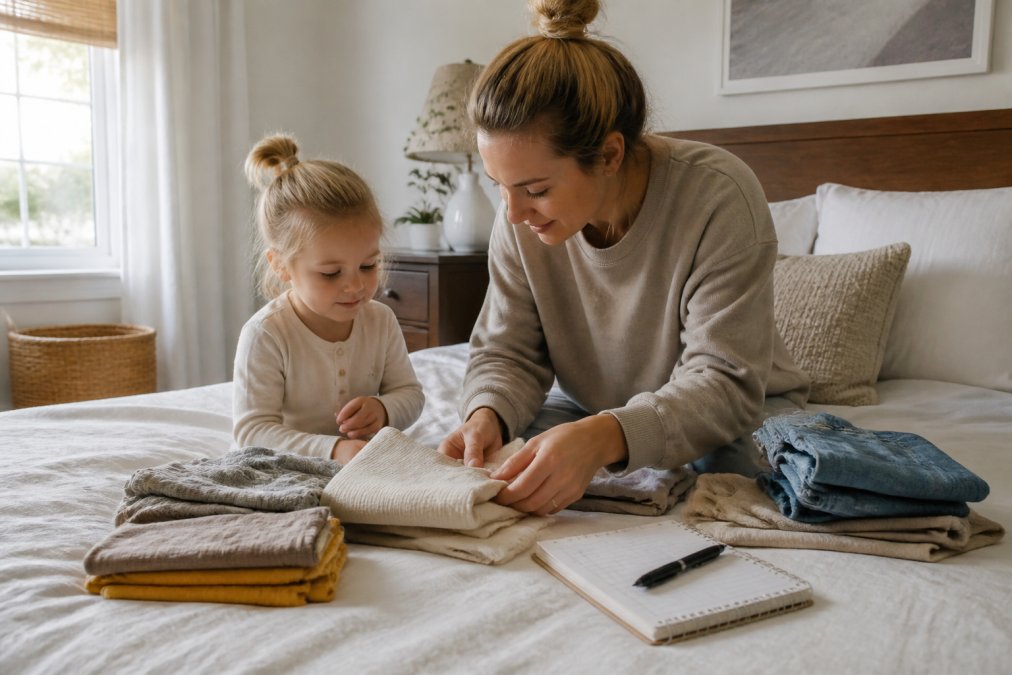
Start with a count that matches your laundry routine, not a number you saw online.
- 6 to 8 tops
- 4 to 5 bottoms
- 2 to 3 layers (vest, cardigan, or jacket)
- 1 to 2 pairs of shoes
- 1 dress or button-down for events
Step 4: Select Durable Fabrics and Layering Pieces
Durable fabrics are the ones that survive repeated washing without pilling, fading, or losing shape. For kids, cotton, twill, and cotton blends hold up best because they breathe and take a beating.
Look for these quality signals before you buy:
- Reinforced stitching at seams and pockets
- Buttons sewn on tightly, not glued
- Fabric that feels soft but not thin
- Elastic waists with a working drawstring for growing kids
Step 5: Plan a Seasonal Clothing Rotation for Kids
A seasonal rotation is not just "put the shorts away." It is the mechanism that keeps a small capsule working across a year of weather, and it looks different depending on where you live. A capsule built for a mild coastal winter will fail a child in a region with real freezes, and vice versa. Build the rotation around your actual climate, not a generic four-season template.
Start with a two-tier system: core and seasonal.
- Core pieces stay in the drawer year-round: plain tees, one or two pairs of pants, underwear, socks, one light layer.
- Seasonal pieces rotate in and out: shorts and sandals in warm months, fleece and insulated layers in cold months.
Match the rotation to your climate.
| Climate pattern | What stays out year-round | What rotates |
|---|---|---|
| Warm most of the year | Tees, shorts, light pants, one light layer | A single cold-weather layer for the few cool weeks |
| Cold winters, warm summers | Tees, pants, one mid-layer | Heavy coat, fleece, thermal base layers, boots |
| Four distinct seasons | Tees, pants, one light layer | Shorts and sandals in summer; insulated layers and boots in winter |
| Wet or humid year-round | Quick-dry tops, one water-resistant layer | Extra socks and a second pair of shoes to rotate while one dries |
- A short-sleeve tee as the base
- A long-sleeve shirt or light cardigan as the mid-layer
- A vest or light jacket as the outer layer
- Wash and dry everything fully before it goes in a bin. Stains set over months, and damp fabric grows mildew.
- Fold, do not hang, knitwear and anything with elastic, hangers stretch shoulders and waistbands over time.
- Use clear, labeled bins by size and season so you can see what you have without opening every box.
- Add a cedar block or lavender sachet to deter moths, especially for wool and cotton knits.
- Store bins somewhere dry and temperature-stable, a closet or under-bed space beats a damp garage or attic.
- Pull out the bin for the incoming season
- Try on the two most-worn pieces from that bin for fit
- Move anything too small to the outgrown bin
- Move the outgoing season's items into storage, clean and folded
Step 6: Manage Growth Spurts and Laundry Cycles
Most capsule guides hand you a fixed number, six tops, five bottoms, and never explain where that number comes from. The real driver is your laundry cycle. A capsule is only as small as your wash schedule allows, because a child cannot wear a shirt that is sitting in the hamper.
| Wash frequency | Days of clothing needed | Tops | Bottoms | Underwear/socks |
|---|---|---|---|---|
| Every 2-3 days | 4-5 | 5-6 | 3-4 | 6-8 |
| Twice a week | 5-6 | 6-8 | 4-5 | 8-10 |
| Once a week | 8-9 | 8-10 | 5-6 | 10-14 |
- Current bin, everything that fits and is in season, living in the dresser.
- Next-size bin, one size up, clean and folded, labeled by size and season. Check it at every seasonal swap so you are not buying blind.
- Outgrown bin, anything too small, washed and folded, ready to hand down, sell, or donate.
- Elastic waists with a working drawstring or button-hole elastic
- Cuffs that can be rolled or let down
- Straight-leg or relaxed cuts that do not pinch at the knee
- Layering pieces (vests, cardigans) that fit across two sizes
Step 7: Add Stylish Matching Family Outfits for Photos
Stylish matching family outfits for photos work best when they follow the same palette as your child's capsule. You do not need identical outfits. Matching colors and tones look better in photos than copy-and-paste looks.
- Pick one base color for everyone (navy, cream, or olive)
- Add one accent that ties the group together
- Mix in different textures so no two people look the same
- Keep patterns small and limited to one or two people
Conclusion
Building a capsule wardrobe for kids takes one honest audit and a short checklist, not a big budget. The hard part is sticking to the plan when sales and new arrivals tempt you.
Frequently Asked Questions
What is the 3-3-3 rule for a capsule wardrobe?
The 3-3-3 rule suggests choosing 3 tops, 3 bottoms, and 3 pairs of shoes as a starting point for a mini capsule. For kids, this translates to 3 everyday tops, 3 bottoms, and 3 footwear options that mix and match. It's a simple way to test whether a capsule wardrobe for kids works for your family before committing to a full closet overhaul. Many parents find this small set covers about a week of outfits when combined with layering pieces.
How many items should be in a child's capsule wardrobe?
Most kids' capsule wardrobes include 20 to 30 items total, depending on age, climate, and how often you do laundry. A typical mix might be 8 tops, 5 bottoms, 3 layering pieces, 2 pairs of shoes, and a few accessories. If you wash clothes twice a week, you can lean toward the lower end. If laundry happens once a week, aim for the higher end. The goal is enough outfit combinations without overflowing drawers.
How do you transition a kids' capsule wardrobe between seasons?
Start by pulling out items that no longer fit or suit the weather. Then add a few seasonal pieces like a padded vest or long-sleeve shirts. Keep core items such as jeans, plain tees, and neutral bottoms year-round. A seasonal clothing rotation for kids works best when you store off-season clothes in bins and bring them out only when needed. This keeps the closet focused and makes getting dressed faster.
How can a capsule wardrobe save money for families?
A capsule wardrobe saves money by reducing impulse buys and focusing on versatile pieces that mix and match. When you know exactly what your child needs, you avoid duplicate items and buy only what fills a gap. Durable fabrics and classic colors also last longer and can be passed down to younger siblings. Over time, fewer but better-quality pieces cost less than a closet full of trendy clothes that rarely get worn.